


News
Continental Books
Interview with Alex Day
21st June, 2024
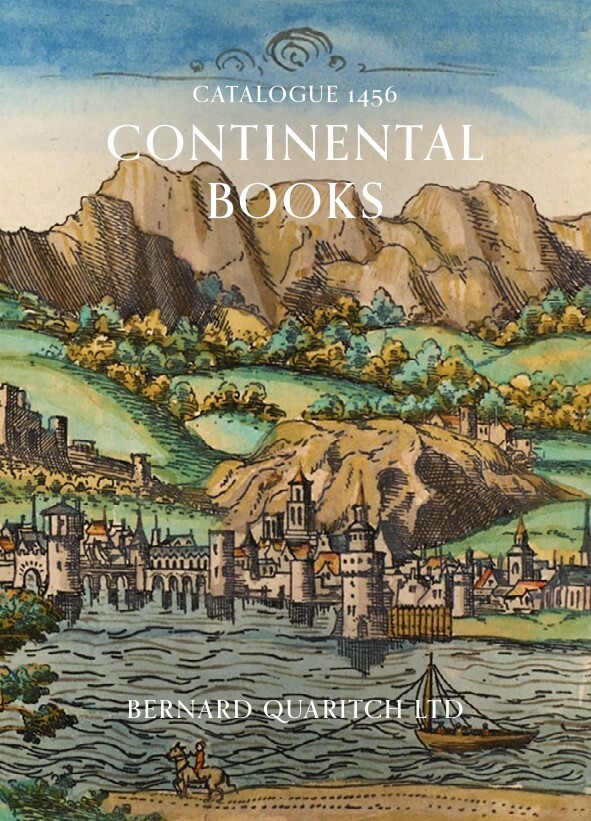
Quaritch has recently released catalogue 1456, which is all about continental books and represents a real team effort. We speak to Alex Day, who joined Q in 2003 with an MPhil in Medieval History from Cambridge. He specialises in manuscripts from that period as well as early printed books and general travel books.
This catalogue offers an exceptional range of continental books, from countries as varied as Sweden and Bohemia. How did you go about choosing them for the catalogue?
‘Continental books’ is a distinctly nebulous catch-all for anything printed on the Continent between the middle of the 15th century and about 1700. It’s an immense field, but within the constraints self-imposed by a catalogue of only sixty items we nevertheless attempted to provide as broad a selection as possible in terms of date and geographical location. The visual element is obviously important too, if one is going to the trouble of printing an extensively illustrated catalogue, so we set aside some particularly appealing items in the year leading up to the catalogue’s compilation.
The price range is also more varied than expected, with prices ranging from £750 to £50,000, which is good to see, especially for new collectors as many would probably assume that this area of book collecting is unaffordable these days. Tell us a bit about some of the books at the lower end and what makes the top end ones so outstanding.
At the lower end, £750 is the price of a charming 1676 edition of Erasmus’s In praise of folly bound in contemporary red morocco. It is delightfully illustrated by engravings of drawings by Hans Holbein and Ambrosius Holbein which appear in the margins of a copy of the 1515 Froben edition. Unusually, six of the engravings are pasted in and folded. At £950 we have a volume containing two works by the church historian and Vatican librarian Emmanuel Schelstrate, which was once in the library of the great German bibliographer Johann Albert Fabricius (1668–1736). At £50,000 is the rare principal work of the Spanish theologian Diego de Deza y Tavera, a defence of Thomas Aquinas printed in Seville in 1491. The volume belonged at an early date to one Brother Albertus at the Royal Dominican monastery of San Pablo in Córdoba. More recently it was part of the wonderful library formed by Estelle Doheny (1875–1958), sold at Christie’s New York between 1987 and 1989. It is the only copy to have appeared at auction for at least the last half century.
In terms of collections, there are two books from the collection of Ulisse Aldrovandi, with his annotations. Please tell us a bit more about the importance of his library.
Aldrovandi possessed a celebrated museum of natural history, containing thousands of specimens of fossils, animals and plants. His library, which has traditionally received less scholarly attention, was equally famed in his day and was housed in two rooms adjoining his museum room. What we know of the library, both in terms of its layout and contents, reflects the diverse interests and hunger for knowledge that characterise Aldrovandi’s life. One of the two volumes in our catalogue contained three works – on cosmology, ethics and astrology – by the Neapolitan humanist Giovanni Pontano (1426–1503). Less expected, perhaps, is the other volume: part one of a collected edition of Petrarch’s Latin works. This had been extensively read by Aldrovandi, who often recorded the date on which he finished reading a particular passage or work. Even at an early date Petrarch was regarded as the father of humanism, so we should not be too surprised at the interest shown in him by Aldrovandi and his contemporaries.
At the recent ILAB symposium there was a lot of talk of heritage and provenance, but we were discussing that books were very often printed with the aim of leaving the country of origin. You have some fine examples of books printed for export, including one printed for the English market by a Parisian woman printer. Please tell us a bit more about it.
It’s a little Salisbury Primer on vellum, printed in Paris in 1528 by Jolanda Bonhomme, the widow of Thielmann Kerver, and it contains a suite of hand-coloured and gilt illustrations bearing captions in English verse. It was evidently intended for an English audience, and it may even have been commissioned by an English bookseller: the colophon mentions one ‘Ansardt Plomier’. We wonder whether this could be a French misrepresentation of an English name, although there was an Alard Plomer or Plomyer who was a French jeweller in the service of Henry VIII.
I loved your headlines in the catalogue, please tell us about ‘Cabbage’ printed by ‘Garlic’.
‘Cabbage’ is the German humanist Joannes Alexander Brassicanus (latinised for Köl, i.e. ‘cabbage’), while the printer of Brassicanus’s learned Hymnus in Apollinem of 1524 was Johann Knoblauch the elder. ‘Knoblauch’ is the German word for garlic. While Brassicanus was, one imagines, very happy not to be referred to by his original German surname, Knoblauch positively flaunted his, both in the woodcut title border incorporating a bunch of garlic bulbs and in the printer’s device at the end of the volume, a strikingly odd image of a personification of Truth emerging from a cave and surrounded by garlic bulbs.
In terms of printing history, which books struck you most?
The 1634 Jansson imprint (Gramaye et al., Respublica Namurcensis, Hannoniae, et Lutsenburgensis) stands out. To find a book of this date in the form of unbound sheets is very unusual, and it offers a tangible insight into the processes involved in setting and printing a pocket-sized volume at that time. The Scalvo (Rosariae preces, 1569) is notable for its extensive use of earlier (late 15th- and early 16th-century) woodcuts. An Italian translation published shortly afterwards by the same Milanese printer employs all the same woodcuts except for one depicting the Virgin Mary in the garden of delight – a mystery!
With the world in the midst of election fever, we should also give some of the politically important books a mention. Augustinus Triumphus’s highly important and influential magnum opus of political theory is certainly one to mention.
We have a copy of the first edition of Augustinus’s Summa de potestate ecclesiastica, an extensive treatise on papal supremacy. It was printed in Augsburg in 1473, although the work itself was completed in 1326 when the Avignon-based Pope John XXII was engaged in an enduring stand-off with the Holy Roman Emperor. It might seem like a work very much of its time, but it holds an important place in the genesis of modern political ideas surrounding the relationship between church and state.
Last, but not least, what was the most astonishing find for you in this catalogue?
Probably the suite of landscape engravings produced in the Low Countries around 1600 (item 30). When we acquired this bound volume of twenty-two engravings, all skilfully hand-coloured and heightened in gold, we expected to find other surviving copies or at least other examples of individual engravings (this might obviously have helped with dating and attribution). To our great surprise, however, we found not a trace – all the landscapes are apparently entirely unrecorded.
More News
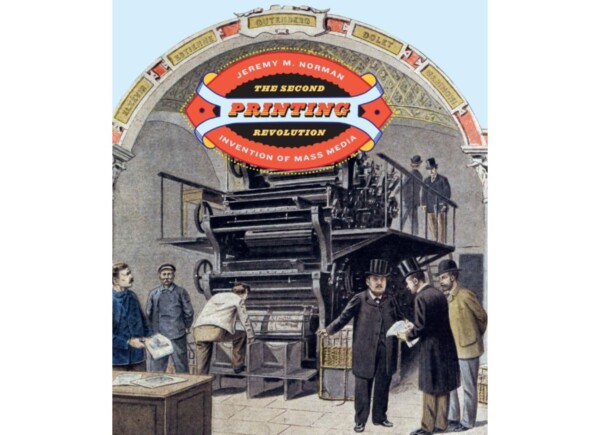
Book Review: The Second Printing Revolution: Invention of Mass Media
30th October, 2026
Paul W. Nash The Second Printing Revolution: Invention of Mass Media By Jeremy M. Norman (New York: The Grolier Club (and University of Chicago Press), 2026. xiii + 296 pp.,…
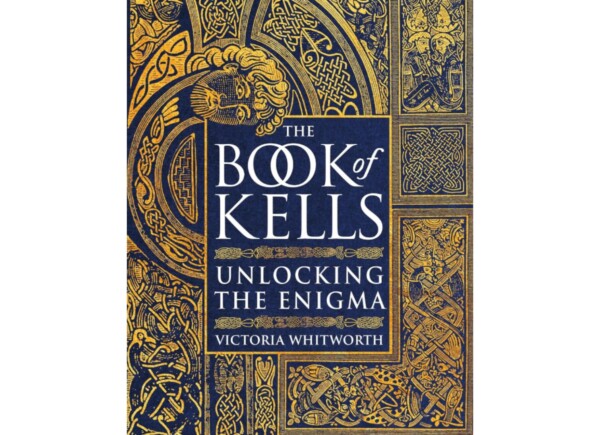
Book Review: The Book of Kells: Unlocking the Enigma
23rd October, 2026
Jeremy Knight The Book of Kells: Unlocking the Enigma By Victoria Whitworth (London: Head of Zeus, 2025. 336 pp., colour illus, £35. isbn 9781788541800) Reviewed in The Book Collector Autumn…

Book Review: The Migrants: A Memoir with Manuscripts
16th October, 2026
Sheila Markham The Migrants: A Memoir with Manuscripts By Christopher de Hamel (London: Allen Lane, 2026. 320 pp., 63 illus, £25. isbn 9780241670125) Anyone in the world of rare…
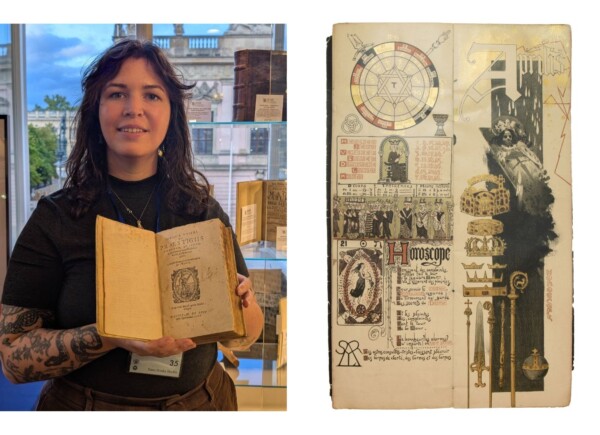
Interview with Clare Marshall and Simon Finch: Weirdiana Catalogue
9th October, 2026
Weirdiana, an exploration of witchcraft, the occult, the mystical and the “out there”, is a collaboration between Clare Marshall of Marshall Rare Books and Simon Finch of Voewood Rare Books….
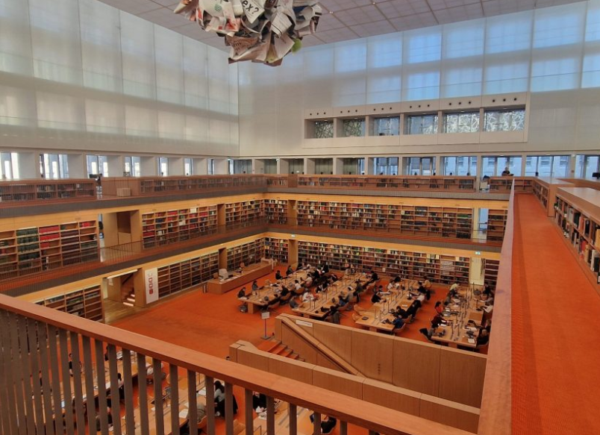
Highlights from the ILAB Symposium 2026
7th October, 2026
The Book Collector team had a very enlightening time at the ILAB Symposium, which was filled with lots of interesting talks and great networking opportunities. The first half of the…
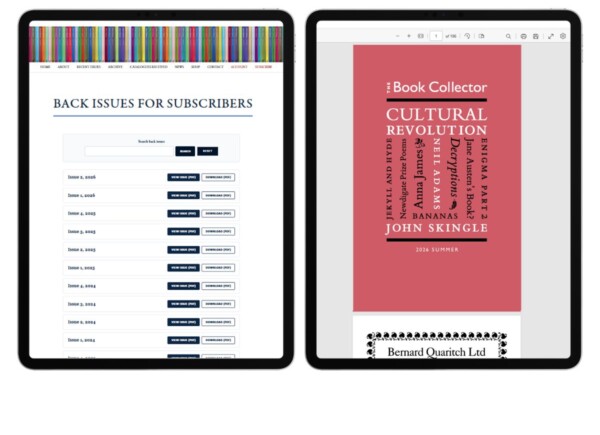
Back Issues: Your PDF Archive Is Back
7th September, 2026
We’re pleased to announce a new addition to your My Account area: Back Issues — giving subscribers simple access to PDF copies of every issue of The Book Collector, from 1947 to the present. When…