



News
Captain Bligh Part 1: The Devil knows how to row
18th June, 2024
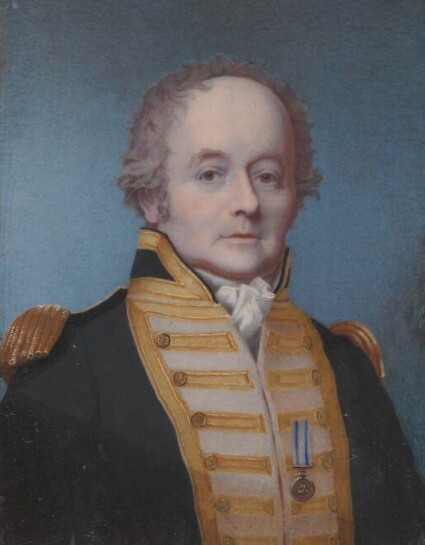
“I have been run down by my own Dogs.” – William Bligh.
A portrait miniature in the National Library of Australia depicts a man in full naval regalia, complete with his captain’s gold medal from the Battle of Camperdown displayed proudly.1 Originally exhibited at the Royal Academy in 1814 the portrait is a remarkable one, a striking image of a curiously bloodless man in naval uniform, high porcelain forehead, thin lips, sad eyes. Painted by a retired soldier making his way as an artist, it is – of course – Rear Admiral William Bligh, aged about 60, newly a widower. This was Bligh as he would have wanted to be remembered: as a veteran of Cook’s third voyage, a Pacific explorer, the friend of Sir Joseph Banks and Lord Nelson, the fourth Governor of New South Wales. As his tombstone would have it three years later, the man who had “transported the bread fruit tree from Otaheite to the West Indies” and “bravely fought the battles of his country.”
In mid-1776, William Bligh (1754—1817) was chosen to be sailing master of HMS Resolution for Captain Cook’s third major voyage to the Pacific. For Bligh, only 21 years old and not blessed with either a particularly well-placed patron or the easiest of tempers, this was an incredible opportunity, one that was all but dashed when Cook was killed in Hawaii three years later. Back in England, Bligh was one of the few to be passed over for promotion and although he was awarded a substantial payment for his work in preparing the voyage maps for publication in the official account (1784), in a particularly stinging omission his name was left off the title-page, replaced with that of the Master’s Mate Henry Roberts (his immediate junior, that is).2 Little wonder, as a classic essay by Rupert T. Gould long ago recorded, that the marginalia in Bligh’s own copy of the book were vitriolic; as Gould wryly notes, “Bligh begins his quarrel with the book on its title page.”3 James King, the main author and surviving commander, even suspected Bligh of threatening to print his own version of events, dangerous territory for any naval officer (especially as Sir Joseph Banks, the eminence grise, considered the writing of these unofficial and often bestselling books as reprehensible).4
Overlooked and at something of a loose end, Bligh spent much of the 1780s in the West Indies trade, when he was approached by Banks to command a voyage to transplant the Breadfruit Tree from Tahiti to the West Indies. This had been one of Banks’s daydreams for more than a decade, ever since he was approached by some of his friends among the West Indies planters who imagined it would be just the thing to supercharge their profits by providing cheaper food to the great slave estates. Bligh certainly took the command with his eyes open. Indeed, later historians can do scarcely do better than to list his reservations regarding the Admiralty’s fit-out of the Bounty: he didn’t sail with enough officers, his surgeon was a tippler with little or no interest in keeping a bright and hygienic ship, he did feel the lack of a body of Marines on board, and worried that they had underestimated the complexity of transplanting hundreds of healthy plants on long voyages. Worst of all, they kept him twiddling his thumbs for so long in port that he caught a bad season to sail, especially as they were insisting he round Cape Horn. Bligh’s bloody-minded attempt to fulfil this last command was the source of much dissension on board, weeks bashing into a gale and making no head-way, before he finally took advantage of a loophole in his instructions and turned and sailed before the Roaring Forties.
In Tahiti, Bligh must have felt that his luck had turned, not least because of his fruitful relationship with the chief, Cook’s old friend Otoo/Tinah (later Pōmare I). With a ship laden with flourishing trees and a crew fit and refreshed, Bligh was clearly feeling supremely confident. Less than three weeks later he was being violently bundled into his own long boat by his great protégé, Fletcher Christian. The scene had its most famous illustration in a large format aquatint issued by Robert Dodd in October 1790, showing ‘The Mutineers turning Lieutenant Bligh and part of the Officers and Crew adrift from His Majesty’s Ship the Bounty.’ Much like other famous Pacific scenes such as the various depictions of the death of Captain Cook in Hawaii, Dodd’s image seems in part based on eyewitness accounts. Bligh stands in the long-boat proud but frantic in his shirtsleeves (in some copies a very pure white, sometimes blue pin-striped). His antagonist, Christian, having just taken the ship and – by most accounts – visibly shaken, stands tall on the stern flanked by two of the breadfruit trees they had been sent to the Pacific to acquire. Indistinctly, in the background, some on board the Bounty seem to dance.
The most striking aspect of the image is the sense of almost total confusion, some smirking or jeering or looking resigned, some swords being handed through the windows while a man in the boat bends low to scoop water in his hat. Most of all, one wonders if Bligh was pleased by the visual confirmation about how crowded the boat appears, even if all the witnesses agreed it was sitting still lower in the water by the time they pushed off. There was jockeying on ship and boat alike, some weeping at being forced to be set adrift and still hoping to regain the relative safety of the ship, others distraught at being forcibly kept on board. It was from the boat that Bligh sang out that he would do justice to those who remained, meant as a comfort to those being detained against their will but, for one of Bligh’s verbal acrobatics, with a hint of menace as well. When the only trial of the mutineers was held three years later in London, the memory of how one had acted during this fraught moment was decisive.
Sign up to The Book Collector newsletter to be among the first to receive our excellent online articles and read more news and reviews from the book world.
Endnotes
2 Banks, ‘Memorandum,’ 28 July 1785, quoted in Beaglehole, Journals, III:1, p. cc, note. In the statement, the deal recorded was that Bligh (actually “Blyth” in Banks’s handwriting) that the initial £100 of his 1/8 share was to be given to estate of William Anderson, the late surgeon, Bligh to retain the rest; if Elizabeth Cook’s half was reputedly £2000, most of an eighth was still an impressive sum.
3 Rupert T. Gould, ‘Bligh’s Notes on Cook’s Last Voyages,’ The Mariner’s Mirror, XIV:4 (October 1928), pp. 371-385.
4 Beaglehole, Journals, III:1, p. ccv. See also Fishburn, ‘The Book that Joseph Banks burned,’ SL Magazine (Summer 2017/2018).
More News

Important Notice: Fraudulent Website Impersonating The Book Collector
15th May, 2026
We have recently become aware of a fraudulent website operating under the domain: www.thebookcollectorjournal.co.uk This website has no affiliation whatsoever with The Book Collector, The Collector Ltd, or our editorial team. It appears to…

Interview with Gordon Brough
10th April, 2026
Gordon Brough is chairman of Sotheran’s. He was born in Dunfermline but brought up in Dundee. He is a collector turned bookseller. When did you come to London? I…
To the Last Scratch of Ink
13th March, 2026
Just in time for International Women’s Month, Peter Harrington have published “To the last scratch of ink”: The Lives and Literature of Women. This catalogue is the third in a…

Spring has Sprung
6th March, 2026
Our Spring 2026 issue has just been published with a suitably daffodil-yellow cover containing a wealth of good things. Cathleen Baker chronicles the story of The Legacy Press, her unique…

Words in Flame
27th February, 2026
As the war in Ukraine enters its fourth year, the toll on the country’s cultural infrastructure continues to unfold. Among the most poignant of these losses are Ukraine’s libraries —…
Oscar Wilde: The Importance of Ephemera
30th January, 2026
With the 125th anniversary of Oscar Wilde’s death only a couple of months ago, Bonhams is still very much on trend with its sale of the collection of Jeremy Mason on 18th February…