


News
Snozzberries, Lickswishy and Gobblefunk: How Roald Dahl Brought Print to Life
Article from Solopress
13th September, 2022
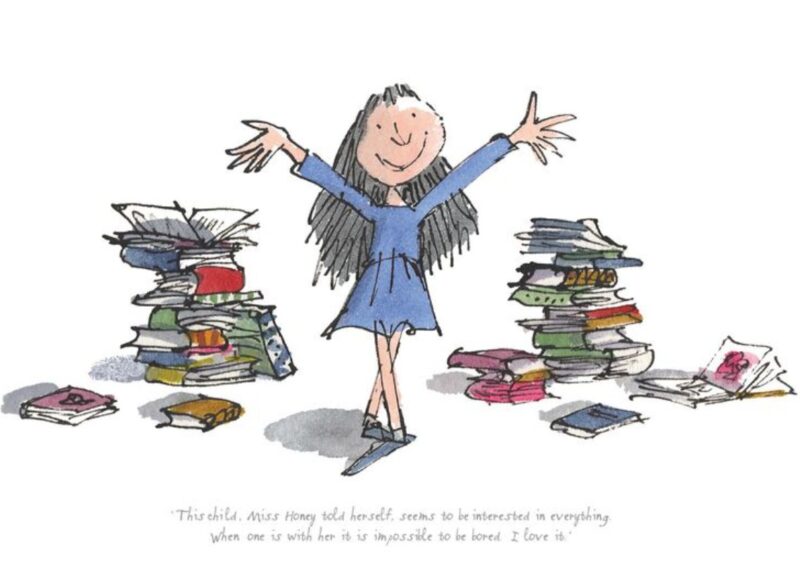
The late author Roald Dahl is responsible for some of the best-loved children’s books of our time. The man behind such whimsical and fantastic favourites as Willy Wonka and the Chocolate Factory, Matilda, The BFG and more has had an enduring impact on the worlds of children’s fiction and print literature. Many of Dahl’s books have gone on to be adapted into critically-acclaimed and commercially successful films, furthering the cultural reach and impact of his stories.
Along with Sir Quentin Blake, his long-term illustrator, Dahl helped capture the imagination of generations of children. But what exactly is it about Dahl’s books that has remained so special to families who’ve read them? Today is Roald Dahl Day (13 September – his birthday) so we thought we’d take a look, with the help of some friends at Solopress, at exactly how the British-Norwegian author was able to bring print to life.
Unique Characters
Perhaps the most memorable aspect of Dahl’s written work is his characters. Using idiosyncratic personalities to capture the imagination of his young audience, Dahl’s characters are as integral to his legacy as the stories they occupy.
Specialising in the weird and wonderful, Dahl’s eccentricity was on full show with characters like the eponymous Fantastic Mr. Fox, the BFG, and the odious Twits. The wacky nature of characters like Willy Wonka and Mr. Centipede lent themselves to the overarching idea that, in Dahl’s world, being unique – or even a little weird – was not only acceptable but encouraged.
Likewise, Matilda – a girl born with telekinetic powers – is very different to her family, but uses her powers in secret to the benefit of her friends and a sympathetic teacher, Miss Honey. Dahl’s stories showed young readers it was ok to be different, capturing their imagination for years to come.
Evil Villains
Dahl’s stories so often followed underdog protagonists with hearts of gold who triumph over their evil adversaries. In many cases, these were children triumphing over adults, making Dahl’s books even more popular with young readers.
In James and the Giant Peach, the book’s antagonists are James’ aunts, Aunt Spiker and Aunt Sponge. In Danny the Champion of the World, the antagonist is Victor Hazell, a wealthy, elderly man. In Matilda, Matilda triumphs over the evil Miss Trunchbull.
Readers loved to hate Dahl’s thoroughly inventive villains, who are usually seen to represent the status quo, before being torn down by heroic children with big ideas and bigger hearts. Dahl used his evil villains’ appearances to teach young readers about the values of being nice, with one paragraph stating:
‘If a person has ugly thoughts, it begins to show on their face. And when that person has ugly thoughts every day, every week, every year, the face gets so ugly you can hardly bear to look at it.’
‘A person who has good thoughts cannot ever be ugly. You can have a wonky nose and crooked mouth and a double chin and stick-out teeth, but if you have good thoughts they will shine out of your face like sunbeams and you will always look lovely.’
Dahl’s villains are key to the enduring cultural success of both his books and their film adaptations.
Inventive New Words
Dahl set himself apart from other children’s authors by using nonsensical and unique words. Both memorable and fun, Dahl used linguistic techniques like spoonerisms and malapropisms to add a further element of uniquity to his writing.
Spoonerisms – swapping elements of words for each other – appear throughout the BFG. ‘Catasterous disastrophe’ is used instead of disastrous catastrophe, and ‘jipping and skumping’ instead of skipping and jumping.
Dahl was also well-known for inventing his own words, which may have seemed non-sensical, but followed the conventions of the English language to ensure that children could understand them perfectly well.
It’s evident which of Dahl’s own words were negative: ‘snozzcumber, squiddler, gobblefunk,’ and which were positive: ‘glumptious, scrumdiddlyumptious.’ Dahl’s words were designed with the same child-like playfulness as his characters and his stories; he was ‘desperate for children to read and to have fun when they were reading.’
Dahl’s use of language helped bring his work off the page and into real life. His use of unique words endures because, on the simplest level, he created words that were fun for children to sound out. His use of words encouraged children to engage with print media in the real world, ensuring the long-term memorability of his work.
Illustrations
It would be unfair to heap all of the praise on Roald Dahl, however. For many people, growing up with his work also meant growing up with the illustrations of Sir Quentin Blake, an established author in his own right who provided art for 18 of Dahl’s books.
Simplistic and fun, Blake’s style was a perfect foil for Dahl’s words. His illustrations gave a reference point for young readers to pair with Dahl’s rich description, capturing the sentiment of each character with his accessible drawing style.
Glen Eckett, Head of Marketing at Solopress, comments: “Roald Dahl’s vivid description and imagination, coupled with the illustration of Quentin Blake, has brought stories and ideas leaping off the page like few others. It’s important that we remember and honour one of the great storytellers of the print medium, as stories such as his should never be forgotten.”
If you’d like to take inspiration from Roald Dahl Day, there are plenty of ways that you can celebrate the life and work of this amazing author. You can find a list of fun, child-friendly activities here.
‘A little nonsense now and then is relished by the wisest men.’ – Roald Dahl.
This feature comes from print and branding experts Solopress, who have provided online printing services for over 23 years, and are dedicated to helping the print medium adapt with modern technology.
More News
Book Review: The Second Printing Revolution: Invention of Mass Media
30th October, 2026
Paul W. Nash The Second Printing Revolution: Invention of Mass Media By Jeremy M. Norman (New York: The Grolier Club (and University of Chicago Press), 2026. xiii + 296 pp.,…
Book Review: The Book of Kells: Unlocking the Enigma
23rd October, 2026
Jeremy Knight The Book of Kells: Unlocking the Enigma By Victoria Whitworth (London: Head of Zeus, 2025. 336 pp., colour illus, £35. isbn 9781788541800) Reviewed in The Book Collector Autumn…
Book Review: The Migrants: A Memoir with Manuscripts
16th October, 2026
Sheila Markham The Migrants: A Memoir with Manuscripts By Christopher de Hamel (London: Allen Lane, 2026. 320 pp., 63 illus, £25. isbn 9780241670125) Anyone in the world of rare…
Interview with Clare Marshall and Simon Finch: Weirdiana Catalogue
9th October, 2026
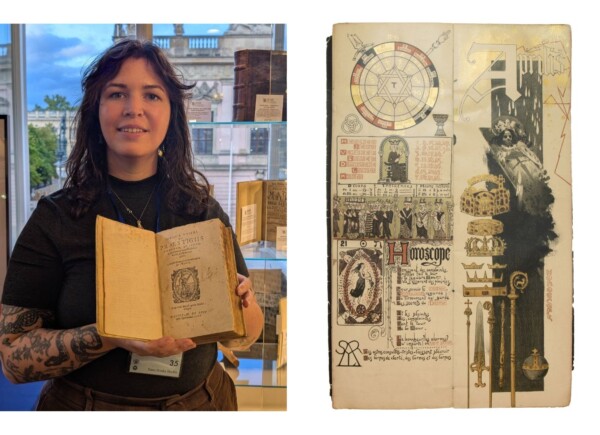
Weirdiana, an exploration of witchcraft, the occult, the mystical and the “out there”, is a collaboration between Clare Marshall of Marshall Rare Books and Simon Finch of Voewood Rare Books….
Highlights from the ILAB Symposium 2026
7th October, 2026
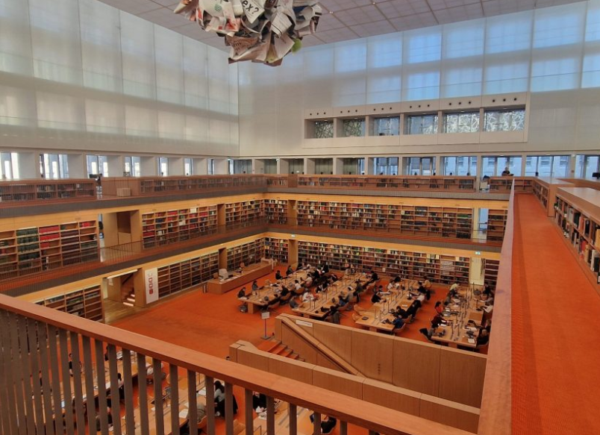
The Book Collector team had a very enlightening time at the ILAB Symposium, which was filled with lots of interesting talks and great networking opportunities. The first half of the…
Back Issues: Your PDF Archive Is Back
7th September, 2026
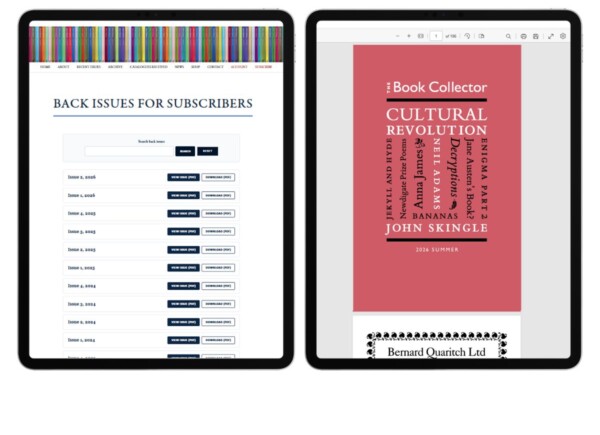
We’re pleased to announce a new addition to your My Account area: Back Issues — giving subscribers simple access to PDF copies of every issue of The Book Collector, from 1947 to the present. When…