



News
The Performing Arts: an interview with Neil Pearson
19th June, 2025
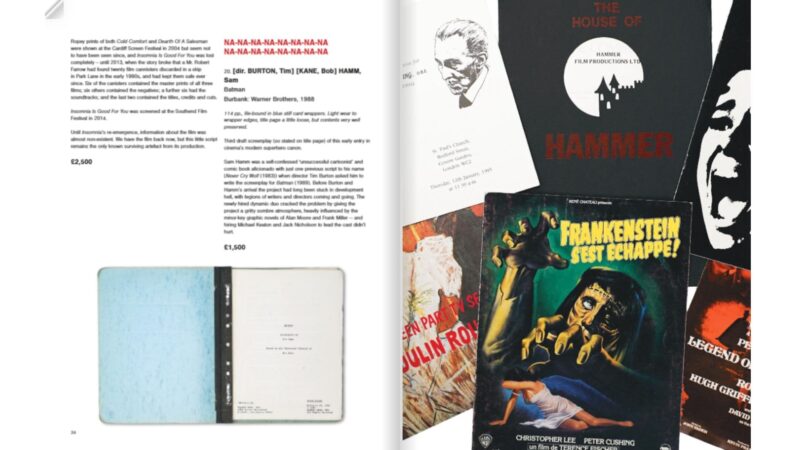
This week Silke Lohmann has interviewed Neil Pearson about his latest catalogue, which covers the great and the good in the performing arts. It’s a catalogue co-production by Neil Pearson Rare Books and Thomas Carter Rare Books and here Neil describes some of the highlights.
Neil, congratulations on your latest catalogue, which certainly covers all the performing arts. Tell us about your collaboration with Thomas Carter Rare Books for this catalogue.
Tom Carter is a new book dealer, based in Glasgow: very good, very keen and depressingly young. I first met him a couple of years ago at the Edinburgh Book Fair, where he was exhibiting for the first time. His stock was both distinctive and impressively high-grade for someone so new to the business and his ability to source material, whether from clients no one else has, or auction houses no one else has heard of, is second to none. We were both keen to put together a list of Performing Arts material, so we decided to join forces to split the risk, share the fun and learn from each other.
You have managed to come up with a great ‘cast’ for your catalogue, from Visconti to Sondheim. You have indeed got some of the best writers, directors and performers included, but I can’t deny that I was a bit surprised to find Kim Jong Il among them – tell us about the infamous book on film theory.
Kim Jong Il ruled North Korea from 1994 until his death in 2011. An avid film buff, he published his On the Art of the Cinema in 1973. The English-language edition followed in 1989 and is extremely scarce: we can find no other copy but the one featured in our catalogue. In 1979 Kim had North Korea’s security forces kidnap two of South Korea’s leading film makers: they were brought to Pyongyang and forced to make films for the glory of North Korea, only managing to escape seven years later. Books published in Pyongyang are very scarce in commerce. This title is truly rare and its backstory is jaw-dropping.
Among the scripts is Christopher Miles’s heavily annotated director’s working script of Neck, the sixth episode of Roald Dahl’s Tales of the Unexpected, plus other archive material and photographs from the set. In fact, you have several items from this director – how did you come by them?
We’re fortunate to have acquired Christopher Miles’s working archive. His career straddled both TV and film, and as he often produced his own projects his working scripts are frequently accompanied by large paper archives which give a fascinating (and research-rich) insight into how his films came to be made – among them two important D. H. Lawrence films: The Virgin and the Gypsy (1970) starring Joanna Shimkus and Franco Nero, and Priest of Love (1981), the story of the publication of Lady Chatterley’s Lover in 1928, which starred Ian McKellen as Lawrence in one of his earliest leading film roles.
I like the story of the lost Peter Sellers film. Presumably this shooting script and the film rolls weren’t found together?
No. In 1957 Sellers, not yet a star, made three shorts, all of them comic pastiches of government information films. One of them, Insomnia Is Good For You, was lost until the early 1990s, when the masters of all three films were saved from a skip by a Mr Robert Farrow (blessed be his name). The film was re-premiered at the Southend Film Festival in 2014. Our copy of the script came from a separate source, a comedy writer who amassed a wealth of material (his own and others’) over a long and distinguished career. Apart from the physical film itself, this copy of the script of Insomnia Is Good For You is the only known surviving artefact from the production.
You have a whole section on ‘Hammer & Hammer Adjacent’ – were these items all part of one collection?
This material was brought together from a variety of sources. Horror films generally, and Hammer in particular, are very popular areas of specialism for collectors of film material, and we were keen to ensure that their interests were well provided for in the catalogue.
Scripts aside, your catalogue also includes signed film posters and original costume designs. Does this attract a different audience, or do you find that most collectors buying from you have a broader approach to their collections?
Private collectors tend to specialise, but institutions cast their nets more widely, looking to cover all aspects of production so that their collections tell as complete a story as possible.
The Homes of the Stars tourist map of Hollywood from 1946 really amused me – celebrity hunting is clearly not a new thing. Judging by the ticks on the map, it was well-used by its previous owner. Presumably ephemera like this is exceptionally rare? What item in the catalogue surprised you most?
I’m very fond of the call sheet for a day’s filming on Alfred Hitchcock’s 1951 classic Strangers On A Train – and not just any day’s filming but filming of the climactic fairground scene. Call sheets – the printed order of work for a day’s filming, distributed to cast and crew at the end of the preceding day – survive very rarely: their information is only useful for a single day, and they’re almost always thrown away once they’re no longer useful. It’s a long way from being the most expensive item in the catalogue, but the miracle of its survival gives me a real thrill.
One of the most expensive items in your catalogue is actor Mark Burns’s heavily annotated and inscribed working script of Luchino Visconti’s Death in Venice at £15,000 – is that down to the fame of the actors or director or the film in general? The more changes to the script, the better?
The script’s provenance, its annotations (which make this copy unique), and the enduring stature of the film itself all contribute to the item’s desirability, and therefore value. This copy also has a 3pp. ALS from Mark Burns describing filming laid in, which adds still more lustre. And the script’s rarity – we can find no record of this final draft of the script ever having been offered for sale before – is the final crowning glory. There’s an interesting difference between books and screenplays when it comes to version desirability. With books, the most desirable state is the first edition, first issue: a book’s very first public bow is the most collectible and valuable version, the presence of its typographical errors (corrected in later impressions) serving as issue points to prove that a copy of the book is in its earliest state. With screenplays, the most desirable version is the latest, the final draft, as this version will be the one which most closely resembles the finished film. And if, as with our copy of Death in Venice, the copy of the screenplay has provenance which places it right at the heart of the making of the film, then you have the most collectible version of all.
The catalogue includes a section on early LGBTQ+ material. Are institutions getting more interested in this area or is it mainly still private collectors?
Gay literature – and especially early gay literature – is a long-established area of collecting for individuals and institutions alike. The category has broadened over the last few years, and interest remains keen. As a result of the current political climate, however, American institutions – historically, assiduous purchasers of this material – are currently not buying for fear of attracting the unwelcome attention of their government, which believes America’s libraries should only be preserving history it agrees with. It’s early days in the skirmish, and I hope I’m proved wrong, but at the moment it appears that, bowing to pressure and motivated by fear, US institutions are doing the government’s work for them.
Your top priced item is an extraordinary copy of Maureen Lambray’s The American Film Directors book of photographs of 82 of the most famous directors alive at the time. This first edition belonged to Herb Yelin (1935–2014), publisher and owner of Lord John Press, who collected autographs, and this book has been signed and inscribed by more than 800 directors, writers and actors. Have you ever handled anything like it before?
Never – and for the very good reason that nothing else like it exists. And what I like about it above all else is that it remains a living thing, a work in progress: there is nothing to stop a future purchaser from continuing to add to the huge roll call of celebrity signatures the volume contains, which will add to the book’s stature (and value) still further.
View the catalogue here >
More News
Important Notice: Fraudulent Website Impersonating The Book Collector
15th May, 2026
We have recently become aware of a fraudulent website operating under the domain: www.thebookcollectorjournal.co.uk This website has no affiliation whatsoever with The Book Collector, The Collector Ltd, or our editorial team. It appears to…

Interview with Gordon Brough
10th April, 2026
Gordon Brough is chairman of Sotheran’s. He was born in Dunfermline but brought up in Dundee. He is a collector turned bookseller. When did you come to London? I…
To the Last Scratch of Ink
13th March, 2026
Just in time for International Women’s Month, Peter Harrington have published “To the last scratch of ink”: The Lives and Literature of Women. This catalogue is the third in a…
Spring has Sprung
6th March, 2026
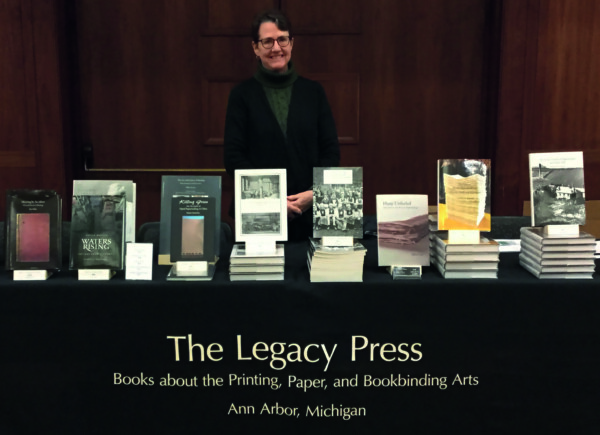
Our Spring 2026 issue has just been published with a suitably daffodil-yellow cover containing a wealth of good things. Cathleen Baker chronicles the story of The Legacy Press, her unique…

Words in Flame
27th February, 2026
As the war in Ukraine enters its fourth year, the toll on the country’s cultural infrastructure continues to unfold. Among the most poignant of these losses are Ukraine’s libraries —…
Oscar Wilde: The Importance of Ephemera
30th January, 2026
With the 125th anniversary of Oscar Wilde’s death only a couple of months ago, Bonhams is still very much on trend with its sale of the collection of Jeremy Mason on 18th February…