



News
Interview with Clare Marshall and Simon Finch: Weirdiana Catalogue
9th October, 2026
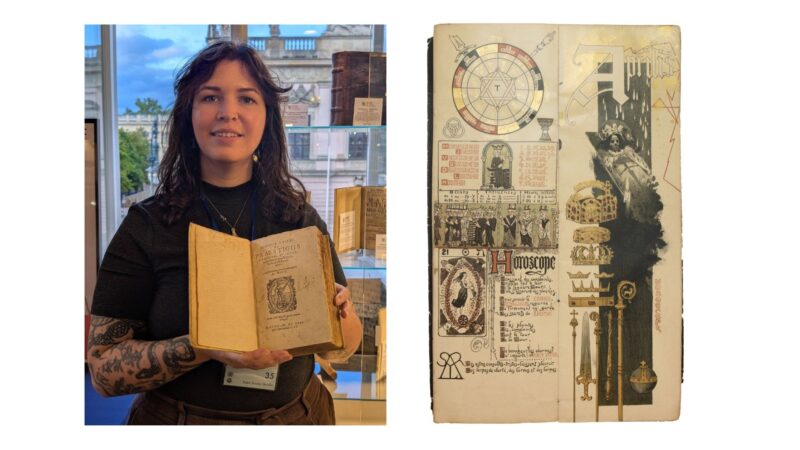
Weirdiana, an exploration of witchcraft, the occult, the mystical and the “out there”, is a collaboration between Clare Marshall of Marshall Rare Books and Simon Finch of Voewood Rare Books. It is officially going to be launched at the Chelsea Book Fair, appropriately the day before Halloween.
Congratulations on your catalogue! You kindly gave us a preview, and it looks very impressive with over 100 books, manuscripts and ephemera beautifully illustrated on over 120 pages. It’s a great idea for a catalogue – what made you work on it together? What was the catalyst?
Clare: For the last few years I’ve been building up stock related to demonology and witchcraft. I think it’s a really interesting subject and it seems to be getting more popular as time goes on. Voewood has always had really interesting and unusual material so when Simon and I were talking at the New York book fair back in April it seemed like a fun idea to combine our different angles and expand it out to more general ‘Weirdiana’.
Simon: It is wonderful to be making a catalogue with Clare and Marshall Rare Books – a firm that I have known for, dare I say it, 50 years. Her last catalogue on witchcraft was terrific, so it is an honour to be collaborating with her. We have used the title Weirdiana as a nod to the late great Martin Stone and the very much alive and equally great Nigel Burwood. They might say something like, ‘Have just bought a great lot of weirdiana, Simon… worth you visiting.’ This would refer to occult books and related subjects.
Which one of the books is your favourite among the ones you contributed to the catalogue, and which one is the one you like best from your colleague’s selection?
Clare: My favourite book that I contributed is probably The Works of Jacob Behmen, The Teutonic Theosopher – a collection of writings by Jakob Böhme. Visually, it has extraordinary layers of illustrations that are so interesting, especially the one showing a person’s soul! Böhme’s work was also hugely important, as he wrote about the nature of evil and the power of rationality. He inspired the philosophers Sigmund Freud and Georg Hegel, as well as poets and artists including William Blake, John Milton and the Pre-Raphaelites.
My favourite of Voewood’s is the Calendrier Magique. I love grimoires and this is such an interesting and unusual example!
Simon: My favourite book of Clare’s is hard to choose. So many things I would like to take home but perhaps I would plump for the 1514 edition of Regiomontanus. A classic compilation of calendars and almanacs in a contemporary binding and with fabulous and vibrant contemporary colour. Like many of us in the book world I am a sucker for early colour in books, and this is a beauty.
My favourite book ? Hard to see past the Calendrier Magique… a tour de force of Art Nouveau book production with its riot of occult images. It is also the last book I sold to Martin Stone just a few days before he died.
There are obviously a lot of books covering witchcraft – both pro and against witch trials. One of the most famous English works on demonology and witchcraft is of course by James I/VI. Tell us a bit more about it and which other works are particularly important in this catalogue.
Clare: When James I ascended the English throne he fully believed in the threat of witchcraft. Earlier in his life he was convinced that he was the target of an assassination attempt by witches causing a storm to try to kill him when he was returning to Scotland with his wife, Anne of Denmark. He was then personally involved in witch trials in Scotland, which resulted in the execution of over 2,000 people.
Before he ascended the throne, a book written by Reginald Scot called The Discoverie of Witchcraft was published that sought to end witch trials in England and was the first book attacking witch trials written in English. When James I came to the throne he ordered all copies destroyed and published his own work.
This is the interesting thing about early modern demonology books; they were often written in response to other works. Johann Weyer was the first to write in defence of those accused of witchcraft, and his ideas are referenced in almost every single work on the subject written after! He is directly denounced as a witch by Jean Bodin in Des Sorciers, Bodin’s work then inspired De Lancre’s witch hunting tactics. In England, More and Glanville had a pamphlet war with Webster that resulted in Glanvill’s Sadducimus Triumphatus and Webster’s The Displaying of Supposed Witchcraft. Abraham Saur’s Theatrum de Veneficis and Del Rio’s Disquitionum Magicarum are both really good compilations of the various understandings of witches – one from a Protestant position, the other from a Catholic.
When Weyer first published De Praestigiis Daemonum he received a huge amount of backlash from both his friends and his critics. When his friends wrote to him asking him to retract some of his arguments he instead doubled down. He expanded De Praestigiis Daemonum and then wrote three more books that made his same arguments dressed up in different ways.
This edition is of special interest because it’s the beginning of the index of demons. This is interesting for two reasons; firstly Weyer isn’t trying to argue that demons don’t exist – this was an argument used by later writers attacking the witch trials. His argument was that demons made deals with Catholic priests, not with unwell old ladies. Secondly, his index was a source for many works on demonology after, for example in Jacques Collin de Plancy’s Dictionnaire Infernal. Famous demons like Asmodeus, Stolas and Behemoth are mentioned here, possibly for the first time.
You have several works relating to Aleister Crowley – not all what you would have expected. Please tell us a bit more about them.
Simon: Yes, the Aleister Crowley annotated book on mountaineering is another book I really like. Mountaineering was an integral part of Crowley’s life and part of his spiritual practice. It is rare to get such a book heavily annotated by Crowley. I shall be sorry to see that one go.
There are a few books on chancers, frauds and quacks – why do you think people are fascinated by them? And what’s the story behind Madame Blavatsky?
Simon: The occult contains so much spiritual wisdom and arcane knowledge and often the books were printed in smallish numbers as the audience was not considered to be large enough to warrant an extensive print run. Also, much was considered to be heretical and in conflict with the established religious orthodoxies.
In this way the occult could be considered a counterculture to the established religions, though often the knowledge imparted was also rooted in science and was not only speculative and mystical. It is a complex and rich field and has periodically been prey to fraudsters and tricksters who wanted to manipulate it for their own gain. This is normal in most fields of human endeavour, and it is fun to represent some of it here, though personally I think Madame Blavatsky was possessed by genius and profound spiritual connection. A towering figure.
You have included two important books by women: one by Mary Shelley and one by Jane Webb. Why are they so significant?
Simon: I am glad that we have copies of two seminal works by women writers. The Mummy is a groundbreaking work of science fiction and was printed in small numbers. It was published in 1827, when its author was 17, and published anonymously. The story of women writers is that often they published anonymously or with a pseudonym because this was deemed to be the better route commercially. Think George Eliot, Austen, the Brontes etc.
Frankenstein by Mary Shelley needs little introduction and it is good to have it here in the increasingly scarce first illustrated edition.
It is way overdue that the female contribution to many areas of endeavour is being belatedly recognised. There is an argument that if they had earlier been given equal opportunity, their achievements might well have eclipsed their male counterparts.
More News

Book Review: The Migrants: A Memoir with Manuscripts
9th October, 2026
Sheila Markham The Migrants: A Memoir with Manuscripts By Christopher de Hamel (London: Allen Lane, 2026. 320 pp., 63 illus, £25. isbn 9780241670125) Anyone in the world of rare…
Back Issues: Your PDF Archive Is Back
7th September, 2026
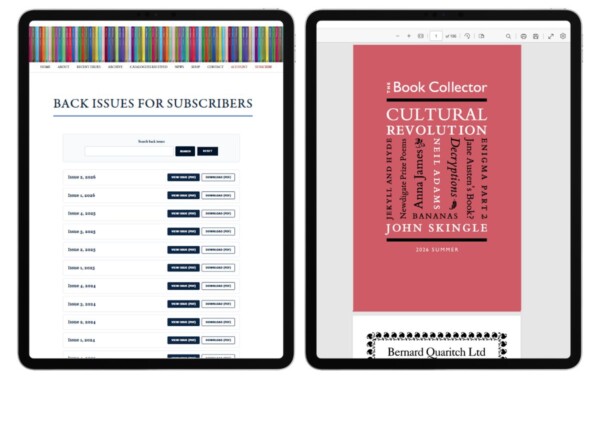
We’re pleased to announce a new addition to your My Account area: Back Issues — giving subscribers simple access to PDF copies of every issue of The Book Collector, from 1947 to the present. When…

Important Notice: Fraudulent Website Impersonating The Book Collector
15th May, 2026
We have recently become aware of a fraudulent website operating under the domain: www.thebookcollectorjournal.co.uk This website has no affiliation whatsoever with The Book Collector, The Collector Ltd, or our editorial team. It appears to…
Interview with Gordon Brough
10th April, 2026
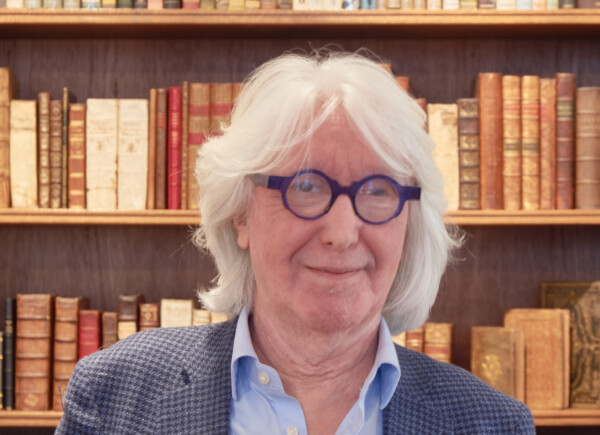
Gordon Brough is chairman of Sotheran’s. He was born in Dunfermline but brought up in Dundee. He is a collector turned bookseller. When did you come to London? I…
To the Last Scratch of Ink
13th March, 2026
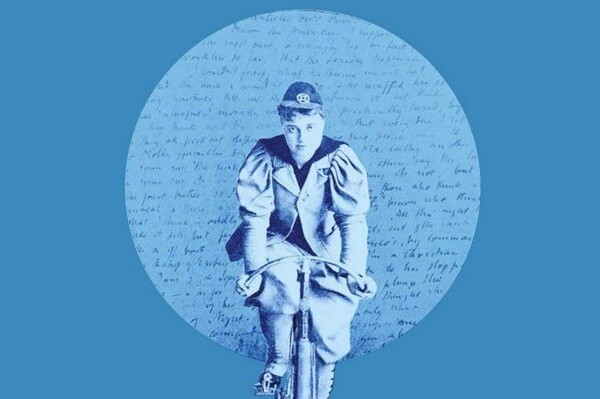
Just in time for International Women’s Month, Peter Harrington have published “To the last scratch of ink”: The Lives and Literature of Women. This catalogue is the third in a…

Spring has Sprung
6th March, 2026
Our Spring 2026 issue has just been published with a suitably daffodil-yellow cover containing a wealth of good things. Cathleen Baker chronicles the story of The Legacy Press, her unique…