



News
Captain Bligh Part 2 – ‘A Bunch of Thieving Jellyfish’
By Matthew Fishburn
3rd July, 2024
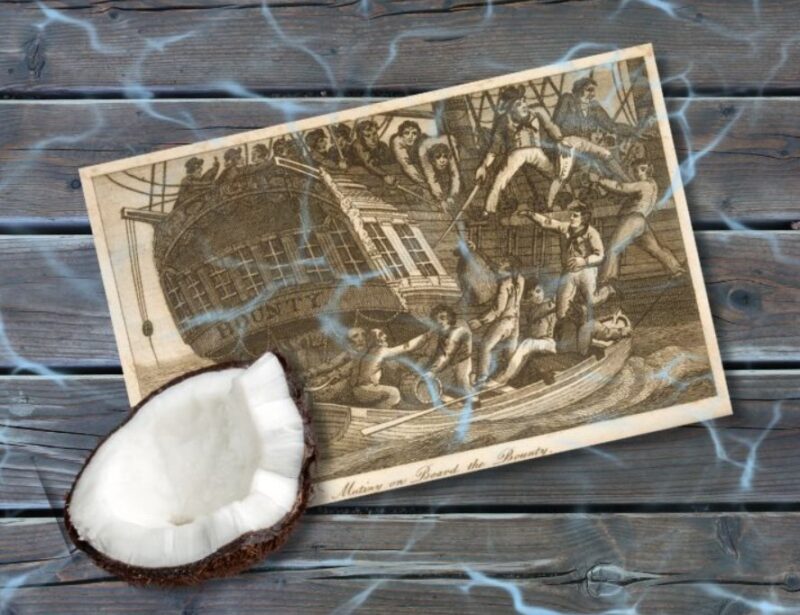
One could go mad trying to understand Christian’s actions in the days before the mutiny while accepting that the mental pressure he was under was immense. He seems to have contemplated setting himself adrift one night, to have got his affairs in order, to have torn up all his letters. Much hinged on a stock of coconuts that had been brought on board, on whether some had been stolen or just borrowed, and precisely what Bligh said when, in one of his rages, he noticed that the piles on deck were noticeably smaller (‘I’ll sweat you for it, you rascals,’ is one version). Despite the profound drama of this moment and the crude theatrics, it is also clear that the taking of the Bounty was, as Paul Brunton once provocatively phrased it, ‘an event of no importance.’[1] Historians have leant towards the coup de foudre argument in which Christian suddenly decided to act, prompted in no small part by the fact that two of his fellow officers on watch were sound asleep. Bligh, however, never gave up on the idea of a premeditated conspiracy rather than a sudden improvised act.
If some among the mutineers thought they were condemning the boat’s crew to certain death, they had underestimated their man. Bligh’s gruelling voyage in the 23-foot-long open-boat with almost no food and little water, is an epic story of endurance. With such gripping material at hand, the first newspaper reports were published in March 1790, while Bligh’s initial account, A Narrative of the Mutiny on board his majesty’s ship Bounty, was published with great haste by George Nicol, appearing on 31 May 1790, although not before one last-minute adjustment, the publisher cancelling leaf C1 (pp. 9–10). This was done so that Bligh could change the line ‘recount to my King and country my misfortune’ to ‘account to my King and country for the misfortune.’[2] Presumably the conversational tone of the initial version was perceived to be a misstep from such a junior officer.
There can be no question that the story transfixed the reading public and so it is little surprise that Nicol’s publication was followed a short four days later by the first of the racy popular accounts, An Account of the Mutinous Seizure, which gauged the popular temper by padding things out with some of the more salacious passages from the account of Cook’s first voyage (a stand-by for satirists of the era), but also added a dramatic frontispiece showing ‘the seizure of Lieutenant Bligh’ in his underclothes.[3] Bligh’s state of deshabille is an easy shorthand for the mood of the author writing about him. Most of all, the story of Bligh was immediately adapted for the stage, a play called The Pirates: Or, the Calamities of Capt. Bligh being a hit for the Royalty Theatre in Wells Street before Bligh’s book was even out.[4]
It is a commonplace that the story of the mutiny on the Bounty is custom-built for film, with three major Hollywood productions (1935, 1962, 1984), all featuring Bligh as a haughty and sometimes vicious autocrat (Laughton – Howard – Hopkins) bent on crushing the spirit of Christian in the guise of a tousled rebel (Gable – Brando – Gibson). We are surely due another. Before Hollywood there were also two Australian films, the first a now lost silent film made in April 1916 and reputed to have been quite balanced – ‘taken from the records of the Mitchell Library’ as the posters had it – and known to have featured King George in a supporting role.[5] This was followed by Errol Flynn’s breakout role, In the Wake of the Bounty (1933), which has the story in its filmic essentials. Bligh is all condescension and grandness: ‘Your choice of seamen surprises me, Mr. Christian’ – elaborate pause for snuff – ‘you’ve picked a bunch of thieving jellyfish.’ Christian, earnest and morose, muttering tonelessly at one point: ‘Aye, but unfortunately we cannot escape from ourselves, nor from our own contempt.’ Then fade to travelogue with semi-nudity, the voice-over in that weird clipped Australian accent well-known to connoisseurs of the 1930s.
In London, after Bligh’s return, the Admiralty made a series of fateful decisions. The first was to equip the Pandora under Captain Edward Edwards, a flogging hardliner who rounded up the mutineers who were left in Tahiti only to lose his ship in the Torres Strait soon after: thirty-one men and four of the mutineers drowned. Edwards, like Bligh before him, limped home on hired ships where he left the writing business to his surgeon George Hamilton, a genial fellow from the glass-of-claret school of voyage books, famous for describing the prison erected on the deck to hold the mutineers as ‘the most desirable place in the ship.’[6]
The second was to encourage Bligh, physically bust and already struggling to clear his name from a ground-swell of rumours regarding his ability to command, to take on a breadfruit voyage redux as commander of the Providence, this time with a small tender the Assistant. Bligh was, many thought, by now ill to the point of insanity and for much of the voyage was so afflicted by migraines that he had to keep to his cabin for days at a time.[7]
A third soon followed, when the Admiralty pressed ahead with the trial of the known mutineers in September 1792, convened when Bligh was still making his successful passage through the Torres Strait on the Providence. So much has been written about the trial that it would be difficult to rehash it here, but in short, those hanged were among the pettiest offenders, a fourth man got off on a well-played technicality spotted by his lawyer, and several who could argue they had been held under duress were acquitted. The three condemned were hanged on board the Brunswick in Portsmouth Harbour at the end of October, the chaplain having preached to them the night before on Hebrews 13:17, ‘Obey them who have authority over you.’[8]
The cause célèbre was surely Peter Heywood. A boy of 15 when he joined the Bounty, Heywood’s role in the mutiny and its aftermath is still debated, chiefly the question of whether he remained on board willingly, but he was the grandest of them to face trial and more determined than any to revive his reputation during a long and successful career in the Navy. He could have hanged and nearly did, saved in no small part by a letter-writing blitz by his devoted sister Nessy but also by a growing feeling in the Navy that Bligh’s conduct had been insufferable. Or, as Bligh’s nephew phrased it, ‘Heywood’s friends have bribed through thick and thin to save him, and from publick report, have not been backward in defaming our Uncle’s character.’[9]
Matthew Fishburn is a writer and rare book dealer based in Bondi, Australia. He is the author of Burning Books and a number of essays on natural history, voyages and early Australia.
[1] Paul Brunton, Awake, Bold Bligh! (Sydney: 1989), p. 1.
[2] John A. Fish, ‘The Cancel in Bligh’s Narrative,’ Script & Print, 43:3 (2019), p. 135.
[3] Anon., An Account of the Mutinous Seizure of the Bounty (London: 1790). See Maggs Bros, Voyages & Travels. Catalogue 1522 (London: 2023), no. 59.
[4] Margarette Lincoln, ‘Mutinous Behavior on Voyages to the South Seas,’ Eighteenth-Century Life, 31:1 (2007), pp. 66—69.
[5] National Film and Sound Archive (Australia), nos. 575001 & 647379.
[6] George Hamilton, A Voyage round the World in His Majesty’s Frigate Pandora (Berwick: 1793), p. 32.
[7] Ida Lee, Captain Bligh’s Second Voyage to the South Sea (London: 1920), pp. 3—4; 33; 81.
[8] Greg Dening, Mr Bligh’s Bad Language (Cambridge: 1992), p. 47.
[9] Thomas Bond to F.G. Bond, 10 November 1792, SLNSW, MLMSS 6422.
More News

Important Notice: Fraudulent Website Impersonating The Book Collector
15th May, 2026
We have recently become aware of a fraudulent website operating under the domain: www.thebookcollectorjournal.co.uk This website has no affiliation whatsoever with The Book Collector, The Collector Ltd, or our editorial team. It appears to…

Interview with Gordon Brough
10th April, 2026
Gordon Brough is chairman of Sotheran’s. He was born in Dunfermline but brought up in Dundee. He is a collector turned bookseller. When did you come to London? I…
To the Last Scratch of Ink
13th March, 2026
Just in time for International Women’s Month, Peter Harrington have published “To the last scratch of ink”: The Lives and Literature of Women. This catalogue is the third in a…

Spring has Sprung
6th March, 2026
Our Spring 2026 issue has just been published with a suitably daffodil-yellow cover containing a wealth of good things. Cathleen Baker chronicles the story of The Legacy Press, her unique…

Words in Flame
27th February, 2026
As the war in Ukraine enters its fourth year, the toll on the country’s cultural infrastructure continues to unfold. Among the most poignant of these losses are Ukraine’s libraries —…
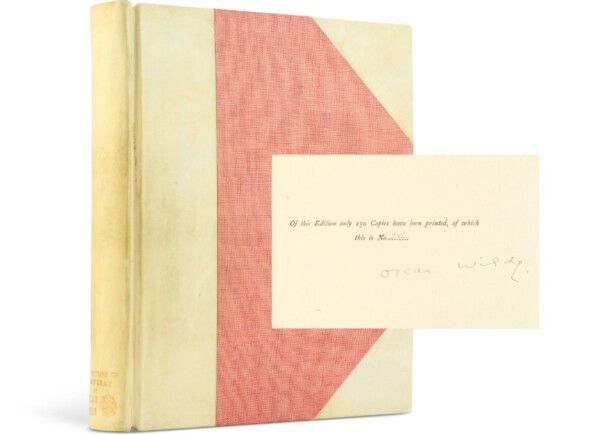
Oscar Wilde: The Importance of Ephemera
30th January, 2026
With the 125th anniversary of Oscar Wilde’s death only a couple of months ago, Bonhams is still very much on trend with its sale of the collection of Jeremy Mason on 18th February…