



News
Interview with Q at Cambridge University Library
9th April, 2024
We are excited to have started our Librarian interviews again – if you would like to be interviewed, please get in touch!
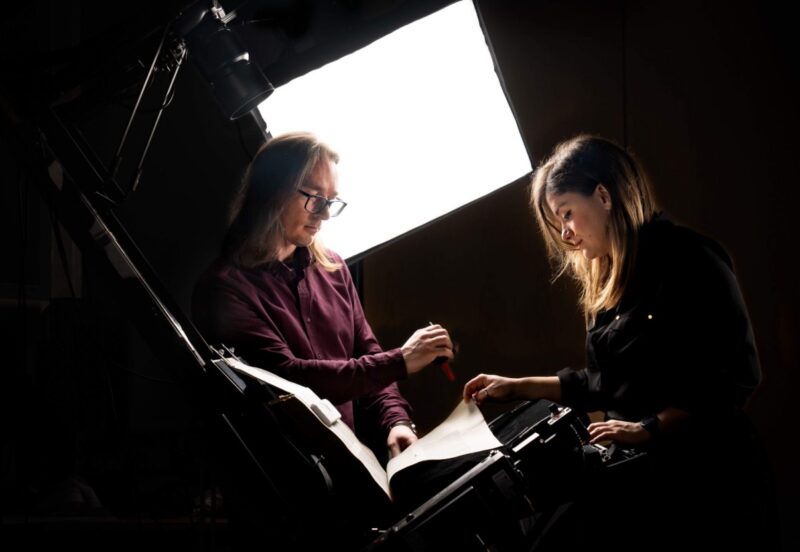
Technically, this month’s interview is not with a librarian, but we have asked Błażej Mikuła, who has been a contributor to The Book Collector and James Fleming’s Bond Behind the Iron Curtain, as we are fascinated by his work for the Cambridge University Library … which is far more technical than you may expect. Here he tells us how he moved from Snappy Snaps to working at the forefront of technology at one of the most prestigious university libraries via a stint as war photographer in Afghanistan.
What’s your job description at the Cambridge University Library?
I currently hold the position of Chief Photographic Technician at the Cultural Heritage Imaging Laboratory at Cambridge University Library. My responsibilities include digitising the library collection and producing short promotional videos. I also find enjoyment in working overtime at the library front desk. This provides me with opportunities to engage with readers and perform typical librarian tasks, such as my favourite: stamping books.
You are not a trained librarian, how did you get started in this field?
I was always drawn to the library as I found myself easily falling in love with the women behind the counter, the librarians. However, that’s not the reason why I was interested in working in such a quiet environment. It all started when I was young, overconfident, and ready for an adventure. Having just left my job at Snappy Snaps, I packed my camera and embedded with the 82nd Airborne, heading to Afghanistan. I was thinking, ‘so far so good,’ a naive approach that my girlfriend did not share. One time, when I had just returned from a Humvee patrol, partially deafened by the 50-caliber gunfire and a large Russian anti-tank mine we had detonated from a safe distance, I logged into my email eager to sell my photos, instead I received a short message from her with a job advert at Corpus Christi College. Something about scanning books. I applied from that plywood-decorated container, and to my surprise, I got the job. The transition from flying Chinooks to digitising MS 286, the manuscript known as the St. Augustine Gospels, was surprisingly smooth, and to this day, I am happy to work in this environment, not as quiet as previously thought.
Over the last decade or so technology has opened library doors to so many more people – which technological advances do you rate most and why?
A plain digital image with spot-on colour accuracy meets most needs, and with easy access to online tools such as IIIF (International Image Interoperability Framework), you can compare digital images across platforms and institutions. However, today’s technology allows us to capture more than what is visible to the naked eye. By utilising different wavelengths, we can penetrate parchment and enhance previously erased secrets. Multispectral photography continues to fuel amazing research that will generate numerous news headlines. It enables us to separate two different inks and suppress one, making the desired script much easier to read. We can process this data in many ways with software that constantly evolves. While this technique is currently complicated and time-consuming, that will likely change in the future.
Are you working on a special project you can share with us at the moment?
No day is just another day in the factory. In the walls of the library, you will find invisible radiation from Curie’s letter, an ectoplasm ‘exteriorized’ by medium Helen Duncan’s most delicate region. She was the last person to be imprisoned under the Witchcraft Act of 1735 in 1944. Or you might even stumble upon breath-taking 3500-year-old ‘dragon’ bones.
These bones are extremely fragile and covered in ancient script used in divination ceremonies in ancient China. People sought advice from gods on topics ranging from military strategy, the harvest, childbirth, and hunting, to the cause of the king’s toothache. Today these bones are about to enter a digital era. We are currently creating high-resolution 3D models. We decided to follow a two-stage workflow. One is to register a highly detailed mesh. This means that all, even the tiny scratches, are captured on the model. Stage two is making a cross-polarized texture that wraps around the mesh. This job is challenging due to the fragility of the objects, but like handling Curie’s letters, we are not alone as we are well supported and guided by our conservation department. I find these bones extremely interesting, and I hope that our 3D scans will be picked up by schools and will lead to further research of this ancient script.
What technologies do you think will be key to libraries in the future?
My first digital camera had 6 million pixels. Compare that to 150 million, and it’s like stepping into a different world. The image quality achievable today with these sensors is truly stunning, and the volume of data they generate is enormous. However, the abundance of beautiful images we capture also presents a new challenge, one that can only be tackled with machine learning algorithms. In the near future, these algorithms will utilise clever lines of code to optically recognize any script and power a search engine capable of pinpointing specific manuscript pages, even those featuring intricate marginalia such as a rabbit riding a dog with a snail on its hand. The future lies in the ability to uncover these hidden gems in already digitised collections.
Have you noticed a change of how students and scholars use your libraries over the last few years?
As a student I was often at the library, so I could flirt with the librarians. I am not aware of this practice taking place today, but I can say for sure that students in Cambridge use the library a lot. Not always in the correct way though. I take issue with readers using highlighters on the books; while I understand that Medieval marginalia is considered a treasure today, it still bothers me to see pencil circles and highlights on the text. That being said, the library, as I perceive it today, serves as a hub for research. The researchers are often coming to our photographic studio with a problem, and we are trying to cast some light on it. Often with satisfactory results. Our library departments are often engaged in various research endeavours, such as for example the ‘Small Performances’ project, aimed at rediscovering lost heritage skills in printing and uncovering the secrets behind the John Baskerville typeface —an amazing project that employs a multidisciplinary approach, creatively combining advanced photographic methods with scientific examination. Apart from that it is still a place where you can get your favourite book, enjoy a cup of coffee, and find a quiet place to study.
Find out more about the Cultural Heritage Imaging Laboratory | Cambridge University Library >
More News
Important Notice: Fraudulent Website Impersonating The Book Collector
15th May, 2026
We have recently become aware of a fraudulent website operating under the domain: www.thebookcollectorjournal.co.uk This website has no affiliation whatsoever with The Book Collector, The Collector Ltd, or our editorial team. It appears to…
Interview with Gordon Brough
10th April, 2026
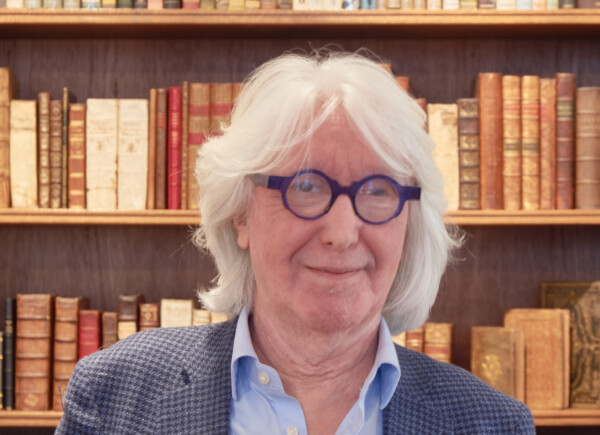
Gordon Brough is chairman of Sotheran’s. He was born in Dunfermline but brought up in Dundee. He is a collector turned bookseller. When did you come to London? I…
To the Last Scratch of Ink
13th March, 2026
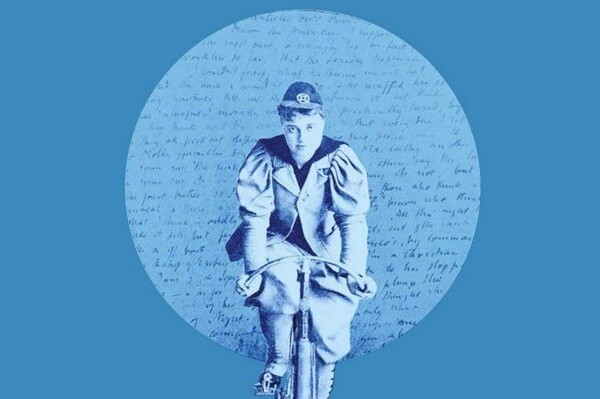
Just in time for International Women’s Month, Peter Harrington have published “To the last scratch of ink”: The Lives and Literature of Women. This catalogue is the third in a…
Spring has Sprung
6th March, 2026
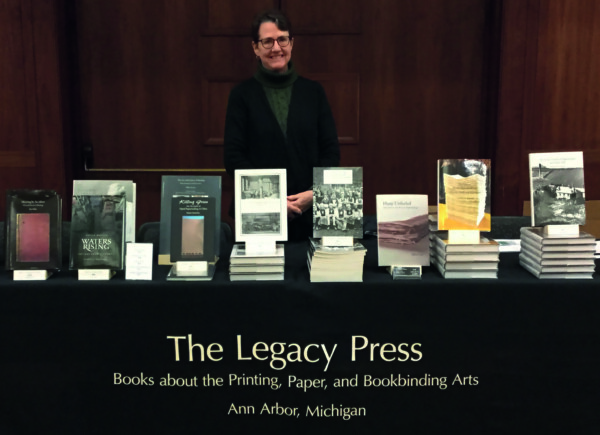
Our Spring 2026 issue has just been published with a suitably daffodil-yellow cover containing a wealth of good things. Cathleen Baker chronicles the story of The Legacy Press, her unique…

Words in Flame
27th February, 2026
As the war in Ukraine enters its fourth year, the toll on the country’s cultural infrastructure continues to unfold. Among the most poignant of these losses are Ukraine’s libraries —…
Oscar Wilde: The Importance of Ephemera
30th January, 2026
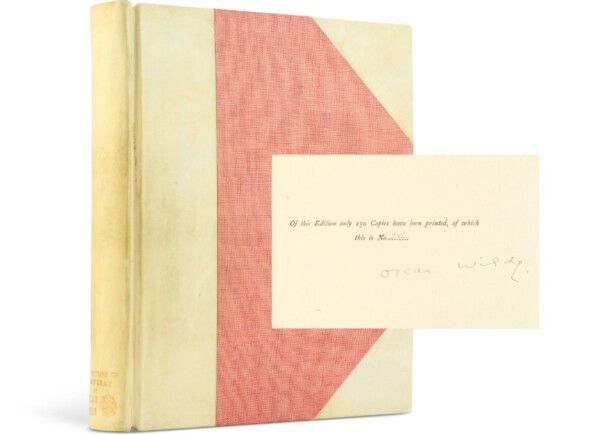
With the 125th anniversary of Oscar Wilde’s death only a couple of months ago, Bonhams is still very much on trend with its sale of the collection of Jeremy Mason on 18th February…