



News
The Kelmscott Chaucer Press and Manor
By Silke Lohmann
28th March, 2023
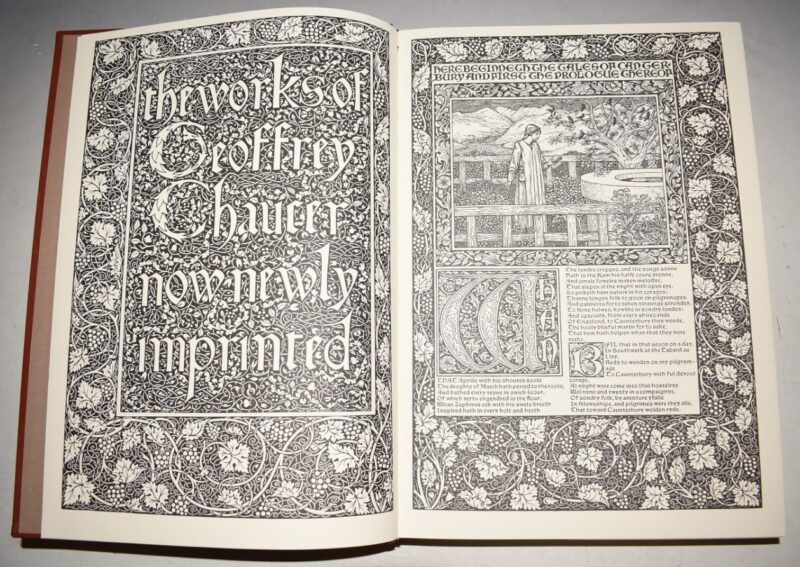
Last week, London Art Week organised a talk as part of its Art History in Focus series about the Kelmscott Chaucer, Press and Manor with Dr Philip Errington of Peter Harrington’s in conversation with Martin Levy, who was instrumental in fundraising the recent renovations of Kelmscott Manor. It is now available on here >
It reminded us how important Morris and the Kelmscott Press were in terms of typefaces and book aesthetics. Founded by William Morris and Emery Walker, the private press only published from 1891 until two years after Morris’s death in 1898. In that time they published fifty three books in sixty six volumes, designed and ornamented by Morris, printed by hand and often illustrated by Burne-Jones. The Kelmscott Chaucer was one of the finest examples of this collaboration and the Pre-Raphaelite artist tried his very best to ensure that the book was ready to be printed shortly before Morris’s death.
Fascinated by medieval book design, Morris and Burne-Jones were regular visitors to the Bodleian Library where they would spend hours examining illuminated manuscripts and the Kelmscott Press tried to replicate the style of 15th-century printing. With the help of book collector Emery Walker, who lived in Morris’s neighbourhood in London, they were aiming to improve the printing quality of books as well as book design and also created several new type fonts. They named their press after Morris’s country retreat in Oxfordshire, Kelmscott Manor.
At the time the Kelmscott Press was set up, modern rotary presses had taken over, but were disliked by many book dealers and designers, but the 19th-century iron-presses were still readily available and it was those that were used at the Kelmscott Press. With their keen interest in typography it is no surprise that Morris designed three typefaces for their press: Golden Type, Troy and a smaller version of Troy, known as Chaucer – focusing on returning to 15th-century designs.
Morris traced the enlarged type until he felt comfortable with his understanding of the design, he then freehanded his own design and Walker used the modern Victorian technology of photography to reproduce them in the correct scale. Some of the Kelmscott books are heavily decorated with motifs similar to Morris’s other designs for upholstery and wallpaper.
After the closing of the Kelmscott Press, leftover paper and the type fonts were given to the Chiswick Press; however, the Kelmscott types were sold to Cambridge University Press in 1940 and later, made part of the Cambridge University Library. Ornaments and other woodblocks were deposited into the British Museum. The presses and accompanying equipment were sold to C. R. Ashbee‘s Essex House Press.
The Kelmscott Chaucer was extremely well reviewed. In 1896 it was called “the finest book ever printed” and the press’s “crowning achievement”. Yeats called it “the most beautiful of all printed books” and an article on the Kelmscott Press in the Academy stated that it was “a great landmark in the history of printing”. It is one of the few books that had its own census in recent years to list who owns copies of this work – the Gutenberg Bible and Shakespeare’s first folio are the others. According to Alan Crawford, a historian of the Arts and Crafts movement, it was “like the Holy Grail tapestries: an intimate collaboration between Morris and Burne-Jones, their masterpiece in that particular medium, and their tribute to an early master of their imagination.”
Some of these tapestries will be on view at Kelmscott Manor this season, on loan from the collection of Baron Lloyd Webber. The manor is opening to the public again on 1st April. The particularly fine example of the Kelmscott Chaucer discussed in the talk is on view at Peter Harrington in Dover Street until the end of this week. The William Morris Society is holding an exhibition until 2nd April “The Ideal Book: William Morris and the Kelmscott Press”, exploring the history and legacy of the Kelmscott Press.
More News

Important Notice: Fraudulent Website Impersonating The Book Collector
15th May, 2026
We have recently become aware of a fraudulent website operating under the domain: www.thebookcollectorjournal.co.uk This website has no affiliation whatsoever with The Book Collector, The Collector Ltd, or our editorial team. It appears to…

Interview with Gordon Brough
10th April, 2026
Gordon Brough is chairman of Sotheran’s. He was born in Dunfermline but brought up in Dundee. He is a collector turned bookseller. When did you come to London? I…

To the Last Scratch of Ink
13th March, 2026
Just in time for International Women’s Month, Peter Harrington have published “To the last scratch of ink”: The Lives and Literature of Women. This catalogue is the third in a…

Spring has Sprung
6th March, 2026
Our Spring 2026 issue has just been published with a suitably daffodil-yellow cover containing a wealth of good things. Cathleen Baker chronicles the story of The Legacy Press, her unique…

Words in Flame
27th February, 2026
As the war in Ukraine enters its fourth year, the toll on the country’s cultural infrastructure continues to unfold. Among the most poignant of these losses are Ukraine’s libraries —…
Oscar Wilde: The Importance of Ephemera
30th January, 2026
With the 125th anniversary of Oscar Wilde’s death only a couple of months ago, Bonhams is still very much on trend with its sale of the collection of Jeremy Mason on 18th February…